PSECS
A persistent multiplayer space game with no user interface. You played it by talking to an AI agent.
It was a technical success and a product failure. That turns out to be the interesting part.
What it was
2024–2026
A persistent universe running on Microsoft Orleans. You ran a corporation: fleets of ships navigating between star systems through wormhole conduits, extracting resources from orbital bodies, feeding them into a seven-tier research tree, manufacturing components and modules, trading on an auction house, and — eventually — fighting other corps.
Every one of those systems fed the next. What you mined determined what you could research. What you researched unlocked what you could build. What you built earned on the market and won in combat.
There was no game client. You played through an MCP server, a REST API, or a command-line tool called papi. In practice that meant you opened Claude and told it what you wanted your empire to do.
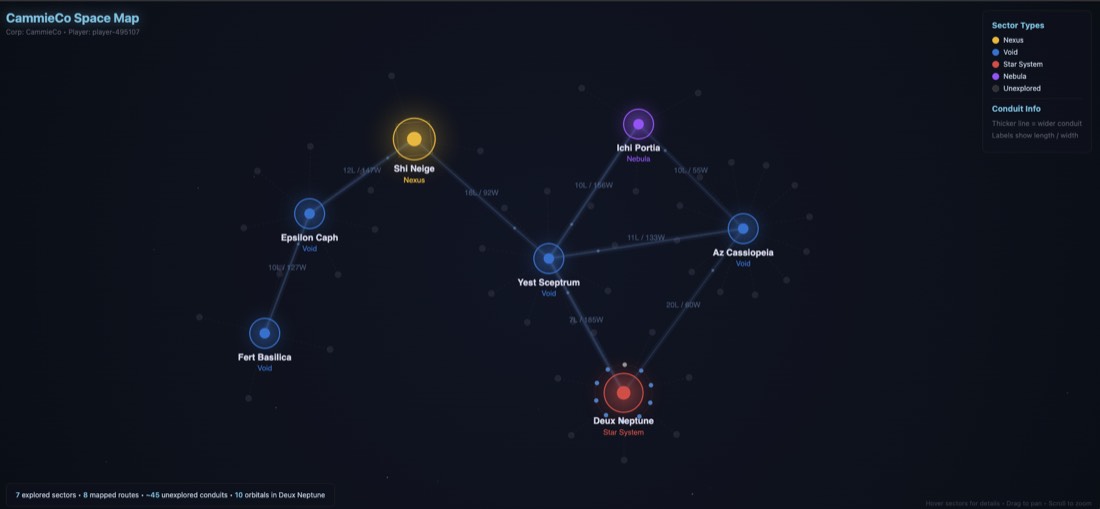
No map screen existed. The agent read the API and drew one.
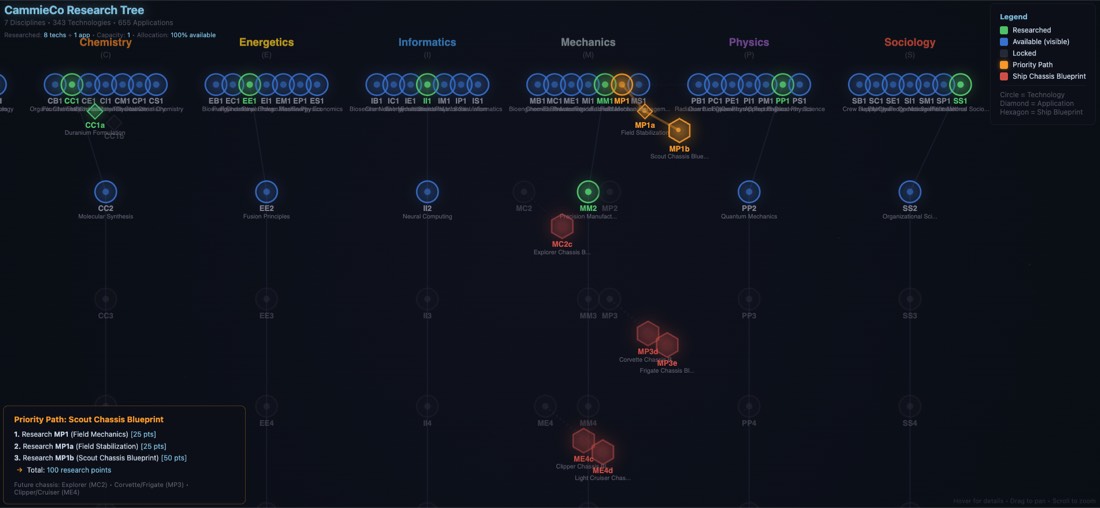
Seven tiers across seven disciplines, with hundreds of interlocking components.
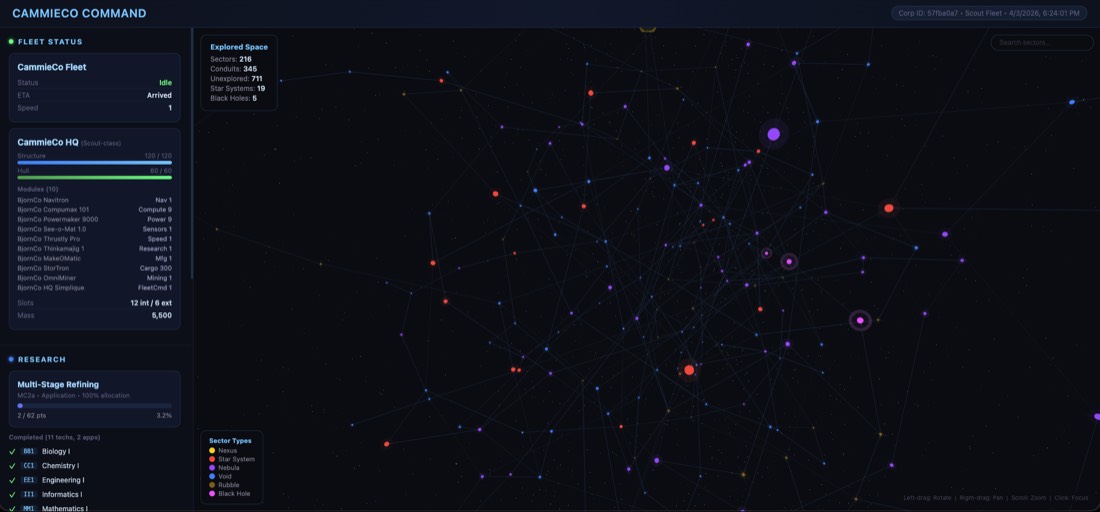
Every player could have a different interface, because nobody shipped one.
How it ended up with no interface
Three decisions, in order
The absence of a UI is the thing people asked about most, and the honest answer is that it arrived in stages and the AI part came last.
- It started as an Orleans experiment, in 2024. I already knew the framework and wanted to find out whether the virtual actor model could carry a persistent multiplayer world — thousands of stateful entities, all addressable, all durable. It can. That part worked from early on and never really stopped working.
- Then I made it CLI-first so players could automate it. The idea was a game you script rather than click: write bots, run strategies, let them play while you sleep. That is where "no UI" actually came from, and it predates the AI angle entirely.
- Then, in late 2025, AI got good. A game already designed to be driven by a machine was an obvious fit for an agent. I rebuilt the front door as an MCP server, partly because it suited the design and partly because I wanted real experience writing one. Development accelerated sharply in January 2026, and the game opened to the public that April.
Why it wasn't fun
The part worth writing down
It was an interesting exercise. It was not a fun game. I want to be precise about why, because "AI-powered game" is going to be a popular idea for a while and the failure mode here is not obvious from the outside.
The agent plays; you wait
When your agent handles extraction, research allocation, cargo, and navigation, your role collapses into approving its decisions. That is not a game loop — it is a management job. The property that made the game automatable is the same property that made it inert to play.
Persistent-world pacing needs a population
Resource spawns expired on a 96-to-192-hour curve. Transit time was conduit length over fleet speed. Research and manufacturing ticked once a minute. Those numbers are reasonable for a world with people in it, where the gaps are filled by other players doing things to you. Alone, the gaps are just gaps.
A competent agent flattens the challenge
Claude can read the entire tech tree and compute an optimal path through it instantly. It does not misjudge a market price or forget a research queue. The planning was arguably the actual game, and the agent dissolved it.
An agent that plays competently raises the floor of complexity your design has to clear. To put the challenge back, I would have needed far more interdependent systems and enough players to compete over them. The design budget explodes at exactly the moment the interface gets easier.
— the finding I would keep if I kept only one
And the early game made that worse. Before you reached fleet combat or anything else with real tension, there was a long grind of mining and research with no one to race against. Getting a player to the interesting part was already grueling; making the interesting part hard enough to challenge an AI would have meant building several more games' worth of systems first. That is an investment I was not willing to make.
What the numbers said
Public April – September 2026
I did not have to guess at any of this. The shape of the drop-off says it plainly.
Every account PSECS ever had
Feb 2026 (first test accounts) → Sep 2026 (shutdown)
The game went public in April 2026, and people kept arriving for five months — the last account was created two days before I decided to switch it off. Every one of them founded a corp and ran the first research job. Almost none did anything after that. Two of the three who went deeper were my own accounts; the third was a real player who got further than anyone else and then, like everyone else, stopped.
Nobody ever started a manufacturing job. Nobody ever fought a battle. Thirty-eight items were listed on the market by two corporations and not one of them ever sold. The economy I was most proud of designing never cleared a single transaction between two human beings.
| Stage | Count |
|---|---|
| Accounts created | 33 |
| Corporations founded | 16 |
| Corps that extracted a resource | 12 |
| Corps past the opening research | 3 |
| Manufacturing jobs started | 0 |
| Combat engagements | 0 |
| Completed player-to-player trades | 0 |
That is the funnel of a game that is genuinely interesting to look at and not fun to play. I could have blamed marketing. The drop-off is too early and too total for that to be honest.
What building it with agents taught me
The half of the project that paid off
The first half of this codebase was written by hand, starting in 2024, over a couple of years of evenings. Then in January 2026 I started building with agents in earnest, and the game was public by April. The second half of a multi-year project took three months.
The more useful effect was on risk, not speed. Agents lowered the bar on technologies I had no direct experience with — the Model Context Protocol, Cloudflare tunnels, autonomous bots to play the game against itself. Each of those would previously have been a weekend of reading before I could judge whether it was even the right choice. That changes which projects feel possible, which matters more than the raw throughput.
It also made me build tooling. Driving a codebase this size with agents surfaced the need for structured refinement loops — plan, implement, review, repeat, without a human in every cycle. That tooling outlived the game.
ralph-o-matic
A refinement loop server and an accompanying /feature-pipeline skill, both born directly out of PSECS development. They take a feature from brainstorm through spec, plan, implementation, and review. I still use them daily on other projects.
The game is the part I am switching off. The method I built in order to write it is the part I kept.
Accounts and data
All player accounts, corporations, and game state have been permanently deleted along with the infrastructure. Nothing was retained.
No one was ever charged for anything. The game had a token purchase flow, and the only purchases it ever processed were my own test transactions. There is nothing to refund and no billing relationship to unwind.
Where I went next
I am building other AI-enabled projects now. Most of what I learned here went straight into them.
Visit infonuncio.com →